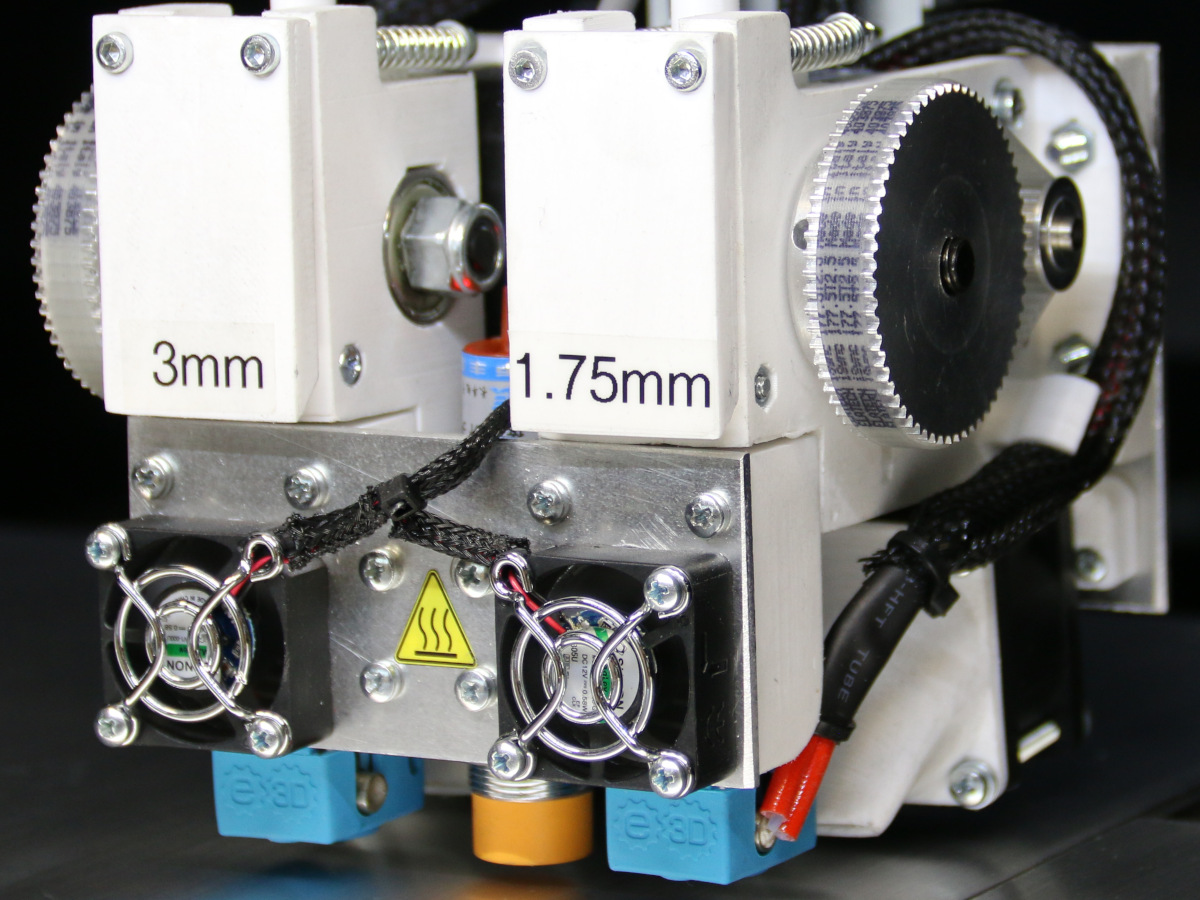
Large-format professional 3D printers are progressively transforming industrial manufacturing processes. The evolution of additive manufacturing allows for the creation of bulky components, functional prototypes, tools, models, and small series directly from digital models, offering new possibilities in terms of flexibility, customization, and production optimization.
The combination of 3D printing, automation, and industrial digitalization is creating more dynamic and adaptable processes. For companies, this means being able to reduce some intermediate steps, rapidly modify designs, and respond more quickly to specific needs.
Large-format printing adds a particularly interesting dimension to this evolution. It’s no longer just about producing small prototypes, but about developing large components using technical materials and increasingly controlled processes. In this context, the professional 3D printer becomes an integral part of a broader industrial strategy.
The evolution of additive manufacturing
Additive manufacturing has evolved from a technology primarily associated with prototyping to a tool capable of participating in various phases of the industrial process.
The principle is relatively simple: a component is digitally developed and then produced by successive material deposition. However, the possibilities offered by this method are much broader. Additive manufacturing allows for the creation of complex geometries, component customization, and rapid design modification without having to rebuild the entire manufacturing process.
When the technology is applied to large components, these advantages become even more important, especially in industries that need to produce bulky components or components tailored to specific requirements.
What are the advantages of a large-format professional 3D printer?
A large-format industrial 3D printer offers a significantly larger build volume than conventional equipment. This allows for the production of components that previously had to be broken down into numerous parts.
Key benefits include:
- Production of large components.
- Reduction of some assembly operations.
- Greater freedom in developing complex geometries.
- Production of full-scale working prototypes.
- Production of custom tools and equipment.
- Possibility of producing small series.
- Greater flexibility in case of project changes.
- Integration with digital manufacturing processes.
The real advantage emerges when large-scale production is combined with a properly digitized workflow.
Digitalization of the production process
Industrial digitalization allows the different phases of the production process to be connected.
The CAD model can be used as a starting point for drawing preparation, parameter definition, and component manufacturing. Subsequently, the manufacturing data can be used to monitor and improve the process.
This connection between design and manufacturing reduces the distance between the virtual and physical environments.
For a company, having a digital process can also make it easier to manage different versions of a component. When the project changes, the new file can be used to quickly produce a new version.
Digitalization therefore promotes more flexible and adaptable production.
3D printing automation
Industrial automation is playing an increasingly important role in the evolution of additive manufacturing.
Automating certain tasks reduces manual intervention and improves process repeatability. Job preparation, monitoring specific parameters, and managing different phases can be gradually integrated into automated workflows.
For a company that frequently uses 3D printing, automation can help with:
- Reduce human error.
- Improve repeatability.
- Reduce preparation time.
- Optimize the use of machines.
- Facilitate production planning.
- Increase production capacity.
Automation doesn’t necessarily mean completely eliminating human intervention. Its goal is to utilize human resources more efficiently and reduce repetitive tasks.
Supervision of the production process
Producing a large component can take many hours. Therefore, process supervision is essential.
Extended printing requires stable conditions to minimize the risk of errors. Monitoring can focus on various variables related to temperature, motion, extrusion, and other process parameters. The more automated the monitoring system, the greater the ability to detect certain anomalies before they cause significant material or time losses.
In this sense, the combination of automation and additive manufacturing can help improve process stability.
Intelligence in production management
The evolution of digital production also allows for the collection of information on printing processes.
Data on times, materials, parameters, and results can be used to identify opportunities for improvement.
This approach allows you to move from a production based exclusively on operator experience to a strategy more focused on data analysis and continuous optimization.
For companies, having historical information can make it easier to repeat work and create specific configurations for different materials and component types.
Innovation in industrial design
Large-scale 3D printing is also opening up new ways to design components.
Additive manufacturing enables the creation of internal structures, complex geometries, and integrated components that would be difficult to produce with some conventional processes. Designers no longer have to think exclusively about how to create a geometry through machining, molding, or other processes. They can develop the component while taking the specific capabilities of additive manufacturing into account from the outset.
Designing for additive manufacturing therefore allows you to combine functionality, weight reduction and material optimization.
Reduction of materials and optimized structures
One of the most interesting features of additive manufacturing is the ability to use material only where it is needed.
In a large component, this option can have a significant impact. Lightweight internal structures can reduce weight and material consumption while maintaining the required application characteristics. The filling, wall thicknesses, and internal geometry can be adapted to the component’s expected behavior.
This strategy allows us to find a balance between strength, weight, costs and production times.
Technical materials for industrial automation
Innovation isn’t limited to machines. The evolution of 3D printing materials is also expanding industrial applications.
Depending on the technology and equipment configuration, different thermoplastic and composite materials can be used.
These may include:
- PLA .
- ABS.
- PETG.
- Polycarbonate.
- Polyamides.
- Fiber-reinforced materials.
- Composite materials .
Engineering materials can be used to develop functional components, tools, and parts for specific applications.
The correct choice must always take into account the conditions of use and the required characteristics.
3DPRN and innovation in large format
In the large-format professional 3D printing industry, 3DPRN is associated with solutions oriented towards large-format additive manufacturing.
Innovation in this field depends on more than just the size of the print area. Precision, stability, material compatibility, and integration options into a production environment are also important factors to consider.
A large format solution can gain greater value when it is integrated into a workflow where design, production and automation are interconnected.
Industrial applications of automated production
The combination of 3D printing and automation can be useful in several industries.
Applications may include:
- Large-scale industrial prototypes.
- Custom tools and materials.
- Assembly models.
- Functional components.
- Short series.
- Technical models.
- Envelopes and structures.
- Custom elements.
- Components for validation processes.
In all these cases, the ability to produce directly from a digital file makes it easier to adapt to ever-changing needs.
Reducing development times
Automation and additive manufacturing can help reduce the time required to develop a component.
When a project can move directly from the CAD environment to production, several intermediate steps are eliminated. Furthermore, if the company adopts standardized procedures, preparing new production runs can be faster. This speed is especially important during prototyping and product validation, where several iterations may be necessary.
A digital modification can be transformed into a new part without having to rebuild the entire process from scratch.
Flexible and customized production
One of the main advantages of automated additive manufacturing is the ability to produce customized components without the need for large volumes. Traditional manufacturing is often optimized for repetitive production. 3D printing allows for modifications to each component as needed.
This opens up new possibilities for on-demand production, limited series and specific components.
The company is able to produce exactly the quantities required and adapt the design to different customers, projects, or conditions of use.
Quality control and repeatability
Automation must be accompanied by an adequate quality control system .
The finished part must meet the specifications established during the design phase. This can be achieved through dimensional checks, visual inspections, and functional tests. Repeatability is particularly important when producing multiple units. The goal is to ensure that each component maintains similar characteristics.
Standardizing parameters and monitoring the process can help improve the consistency of results.
Maintenance optimization
A professional 3D printer used in an industrial environment requires adequate preventative maintenance. Periodic inspection of components helps reduce the risk of unexpected downtime and keep the machine in good working order.
Maintenance can also be integrated into a broader management system, especially when the company uses several machines or performs frequent production runs.
Automating certain monitoring tasks can make it easier to identify potential problems before they impact your process.
The future of automation with 3D printing
The combination of additive manufacturing, automation, and digitalization can progressively transform the concept of industrial production.
Large-format machines can be integrated into increasingly interconnected processes, where digital archiving, production parameters, and quality control are part of a continuous flow. The evolution of materials will enable the development of new applications, while advances in software will facilitate job preparation and optimization.
This means that the 3D printer can cease to be a simple independent machine and become a connected element within the production system.
The large-format professional 3D printer represents a strategic tool for companies wishing to combine innovation, flexibility, and industrial automation.
The ability to produce large components directly from a digital model reduces intermediate steps and facilitates the creation of prototypes, tools, functional parts, and small production runs.
Integration with automation and digitalization systems improves monitoring, repeatability, and optimization capabilities. At the same time, the development of technical materials and more efficient internal structures expands the scope of additive manufacturing.
In this context, large-format 3D printing should not be considered solely as a technology for producing large objects. It represents an opportunity to build more flexible, digital, personalized, and efficient production processes.
As automation advances, the connection between design, manufacturing, and control will become increasingly close. Therefore, large-format additive manufacturing can play a key role in transforming industry, offering companies new tools to innovate and respond more quickly to the demands of modern manufacturing.


